Content
# flyto-core
[](https://pypi.org/project/flyto-core/)
[](https://opensource.org/licenses/Apache-2.0)
[](https://www.python.org/downloads/)
<!-- mcp-name: io.github.flytohub/flyto-core -->
> **A debuggable automation engine. Trace every step. Replay from any point.**
>
> **[flyto2.com](https://flyto2.com)** · [Desktop App](https://flyto2.com/app.html) · [Documentation](https://docs.flyto2.com) · [YouTube](https://www.youtube.com/@Flyto2)
### Try in 30 seconds
```bash
pip install flyto-core[browser] && playwright install chromium
flyto recipe competitor-intel --url https://github.com/pricing
```
```
Step 1/12 browser.launch ✓ 420ms
Step 2/12 browser.goto ✓ 1,203ms
Step 3/12 browser.evaluate ✓ 89ms
Step 4/12 browser.screenshot ✓ 1,847ms → saved intel-desktop.png
Step 5/12 browser.viewport ✓ 12ms → 390×844
Step 6/12 browser.screenshot ✓ 1,621ms → saved intel-mobile.png
Step 7/12 browser.viewport ✓ 8ms → 1280×720
Step 8/12 browser.performance ✓ 5,012ms → Web Vitals captured
Step 9/12 browser.evaluate ✓ 45ms
Step 10/12 browser.evaluate ✓ 11ms
Step 11/12 file.write ✓ 3ms → saved intel-report.json
Step 12/12 browser.close ✓ 67ms
✓ Done in 10.3s — 12/12 steps passed
```
Screenshots captured. Performance metrics extracted. JSON report saved. **Every step traced.**
<p align="center">
<img src="demo/flyto-core-demo.gif" alt="flyto-core demo: API pipeline → replay → browser automation" width="720">
</p>
---
## What happens when step 8 fails?
With a shell script you re-run the whole thing. With flyto-core:
```bash
flyto replay --from-step 8
```
Steps 1–7 are instant. Only step 8 re-executes. Full context preserved.
---
## 3 recipes to try now
```bash
# Competitive pricing: screenshots + Web Vitals + JSON report
flyto recipe competitor-intel --url https://competitor.com/pricing
# Full site audit: SEO + accessibility + performance
flyto recipe full-audit --url https://your-site.com
# Web scraping → CSV export
flyto recipe scrape-to-csv --url https://news.ycombinator.com --selector ".titleline a"
```
Every recipe is traced. Every run is replayable. [See all 32 recipes →](docs/RECIPES.md)
---
## Install
```bash
pip install flyto-core # Core engine + CLI + MCP server
pip install flyto-core[browser] # + browser automation (Playwright)
playwright install chromium # one-time browser setup
```
---
## The 85-line problem
Here's what competitive pricing analysis looks like in Python:
<table>
<tr>
<td width="50%">
**Python** — 85 lines
```python
import asyncio, json, time
from playwright.async_api import async_playwright
async def main():
async with async_playwright() as p:
browser = await p.chromium.launch()
page = await browser.new_page()
await page.goto("https://competitor.com/pricing")
# Extract pricing
prices = await page.evaluate("""() => {
const cards = document.querySelectorAll(
'[class*="price"]'
);
return Array.from(cards).map(
c => c.textContent.trim()
);
}""")
# Desktop screenshot
await page.screenshot(
path="desktop.png", full_page=True
)
# Mobile
await page.set_viewport_size(
{"width": 390, "height": 844}
)
await page.screenshot(
path="mobile.png", full_page=True
)
# Performance
perf = await page.evaluate("""() => {
const nav = performance
.getEntriesByType('navigation')[0];
return {
ttfb: nav.responseStart,
loaded: nav.loadEventEnd
};
}""")
# Save report
report = {
"prices": prices,
"performance": perf,
}
with open("report.json", "w") as f:
json.dump(report, f, indent=2)
await browser.close()
asyncio.run(main())
```
</td>
<td width="50%">
**flyto-core** — 12 steps
```yaml
name: Competitor Intel
steps:
- id: launch
module: browser.launch
- id: navigate
module: browser.goto
params: { url: "{{url}}" }
- id: prices
module: browser.evaluate
params:
script: |
JSON.stringify([
...document.querySelectorAll(
'[class*="price"]'
)
].map(e => e.textContent.trim()))
- id: desktop_shot
module: browser.screenshot
params: { path: desktop.png, full_page: true }
- id: mobile
module: browser.viewport
params: { width: 390, height: 844 }
- id: mobile_shot
module: browser.screenshot
params: { path: mobile.png, full_page: true }
- id: perf
module: browser.performance
- id: save
module: file.write
params:
path: report.json
content: "${prices.result}"
- id: close
module: browser.close
```
</td>
</tr>
<tr>
<td>
No trace. No replay. No timing. If step 5 fails, re-run everything.
</td>
<td>
Full trace. Replay from any step. Per-step timing. Every run is debuggable.
</td>
</tr>
</table>
---
## What's New in v2.19.0
- **Smart validate_params** — auto-corrects wrong field names via alias mapping (e.g., `site` to `url`) and suggests alternatives when a non-existent module is requested
- **Enhanced search_modules** — word-level and tag matching scoring replaces the old substring-only search, producing more relevant results for natural language queries
- **browser.extract default text mode** — when no `fields` are specified, `browser.extract` now returns the text content of matched elements by default (previously returned empty objects)
- **Browser channel support** — pass `channel: 'chrome'` to `browser.launch` to use the system-installed Chrome instead of bundled Chromium, useful for bypassing anti-bot detection on sites that fingerprint headless browsers
## Engine Features
- **Execution Trace** — structured record of every step: input, output, timing, status
- **Replay** — re-execute from any step with the original (or modified) context
- **Breakpoints** — pause execution at any step, inspect state, resume
- **Evidence Snapshots** — full state before and after each step boundary
- **Data Lineage** — track data flow across steps, build dependency graphs
- **Timeout Guard** — configurable workflow-level and per-step timeout protection
---
## 467 Modules, 78 Categories
| Category | Count | Examples |
|----------|-------|----------|
| `browser.*` | 38 | launch, goto, click, extract, screenshot, fill forms, wait |
| `flow.*` | 24 | switch, loop, branch, parallel, retry, circuit breaker, rate limit |
| `array.*` | 15 | filter, sort, map, reduce, unique, chunk, flatten |
| `string.*` | 11 | reverse, uppercase, split, replace, trim, slugify, template |
| `api.*` | 11 | OpenAI, Anthropic, Gemini, Notion, Slack, Telegram |
| `object.*` | 10 | keys, values, merge, pick, omit, get, set, flatten |
| `image.*` | 9 | resize, convert, crop, rotate, watermark, OCR, compress |
| `data.*` | 8 | json/xml/yaml/csv parse and generate |
| `file.*` | 8 | read, write, copy, move, delete, exists, edit, diff |
| `stats.*` | 8 | mean, median, percentile, correlation, standard deviation |
| `validate.*` | 7 | email, url, json, phone, credit card |
| `docker.*` | 6 | run, ps, logs, stop, build, inspect |
| `archive.*` | 6 | zip create/extract, tar create/extract, gzip, gunzip |
| `math.*` | 6 | calculate, round, ceil, floor, power, abs |
| `k8s.*` | 5 | get_pods, apply, logs, scale, describe |
| `crypto.*` | 4 | AES encrypt/decrypt, JWT create/verify |
| `network.*` | 4 | ping, traceroute, whois, port scan |
| `pdf.*` | 4 | parse, extract text, merge, compress |
| `aws.s3.*` | 4 | upload, download, list, delete |
| `google.*` | 4 | Gmail send/search, Calendar create/list events |
| `cache.*` | 4 | get, set, delete, clear (memory + Redis) |
| `ssh.*` | 3 | remote exec, SFTP upload, SFTP download |
| `git.*` | 3 | clone, commit, diff |
| `sandbox.*` | 3 | execute Python, Shell, JavaScript |
| `dns.*` | 1 | DNS lookup (A, AAAA, MX, CNAME, TXT, NS) |
| `monitor.*` | 1 | HTTP health check with SSL cert verification |
See the **[Full Module Catalog](docs/TOOL_CATALOG.md)** for every module, parameter, and description.
---
## How is this different?
| | Playwright / Selenium | Shell scripts | flyto-core |
|-|----------------------|---------------|------------|
| Step 8 fails | Re-run everything | Re-run everything | `flyto replay --from-step 8` |
| What happened at step 3? | Add print(), re-run | Add echo, re-run | Full trace: input, output, timing |
| Browser + API + file I/O | Write glue code | 3 languages | All built-in |
| Share with team | "Clone my repo" | "Clone my repo" | `pip install flyto-core` |
| Run in CI | Wrap in pytest/bash | Fragile | `flyto run workflow.yaml` |
---
## How to Use
<details>
<summary><b>CLI</b> — run workflows from the terminal</summary>
```bash
# Run a built-in recipe
flyto recipe site-audit --url https://example.com
# Run your own YAML workflow
flyto run my-workflow.yaml
# List all recipes
flyto recipes
```
</details>
<details>
<summary><b>MCP Server</b> — for Claude Code, Cursor, Windsurf</summary>
```bash
pip install flyto-core
claude mcp add flyto-core -- python -m core.mcp_server
```
Or add to your MCP config:
```json
{
"mcpServers": {
"flyto-core": {
"command": "python",
"args": ["-m", "core.mcp_server"]
}
}
}
```
Your AI gets all modules as tools.
</details>
<details>
<summary><b>HTTP API</b> — for integrations and remote execution</summary>
```bash
pip install flyto-core[api]
flyto serve
# ✓ flyto-core running on 127.0.0.1:8333
```
| Endpoint | Purpose |
|----------|---------|
| `POST /v1/workflow/run` | Execute workflow with evidence + trace |
| `POST /v1/workflow/{id}/replay/{step}` | Replay from any step |
| `POST /v1/execute` | Execute a single module |
| `GET /v1/modules` | Discover all modules |
| `POST /mcp` | MCP Streamable HTTP transport |
</details>
<details>
<summary><b>Python API</b> — for programmatic use</summary>
```python
import asyncio
from core.modules.registry import ModuleRegistry
async def main():
result = await ModuleRegistry.execute(
"string.reverse",
params={"text": "Hello"},
context={}
)
print(result) # {"ok": True, "data": {"result": "olleH"}}
asyncio.run(main())
```
</details>
---
## 30+ Built-in Recipes
No code required — every recipe is a YAML workflow template:
```bash
flyto recipes # List all recipes
# Audit & Testing
flyto recipe full-audit --url https://example.com
flyto recipe competitor-intel --url https://github.com/pricing
flyto recipe site-audit --url https://example.com
flyto recipe web-perf --url https://example.com
flyto recipe login-test --url https://myapp.com/login --username user --password pass --success_selector .dashboard
flyto recipe form-fill --url https://myapp.com/form --data '{"email":"test@example.com"}'
# Browser Automation
flyto recipe screenshot --url https://example.com
flyto recipe responsive-report --url https://example.com
flyto recipe page-to-pdf --url https://example.com
flyto recipe visual-snapshot --url https://example.com
flyto recipe webpage-archive --url https://example.com
flyto recipe scrape-page --url https://example.com --selector h1
flyto recipe scrape-links --url https://example.com
flyto recipe scrape-table --url https://en.wikipedia.org/wiki/YAML --selector .wikitable
flyto recipe stock-price --symbol AAPL
# Data & Image
flyto recipe ocr --input scan.png
flyto recipe csv-to-json --input data.csv
flyto recipe image-resize --input photo.jpg --width 800
flyto recipe image-convert --input photo.png --format webp
# Network & DevOps
flyto recipe port-scan --host example.com
flyto recipe whois --domain example.com
flyto recipe monitor-site --url https://myapp.com
flyto recipe docker-ps
flyto recipe git-changelog
# Integrations
flyto recipe scrape-to-slack --url https://example.com --selector h1 --webhook $SLACK_URL
flyto recipe github-issue --url https://example.com --owner me --repo my-app --title "Bug" --token $GITHUB_TOKEN
```
Each recipe is a YAML workflow template. Run `flyto recipe <name> --help` for full options.
See **[docs/RECIPES.md](docs/RECIPES.md)** for full documentation.
---
## Write Your Own Workflows
Recipes are just YAML files. Write your own:
```yaml
name: price-monitor
steps:
- id: open
module: browser.launch
params: { headless: true }
- id: page
module: browser.goto
params: { url: "https://competitor.com/pricing" }
- id: prices
module: browser.evaluate
params:
script: |
JSON.stringify([...document.querySelectorAll('.price')].map(e => e.textContent))
- id: save
module: file.write
params: { path: "prices.json", content: "${prices.result}" }
- id: close
module: browser.close
```
```bash
flyto run price-monitor.yaml
```
Every run produces an execution trace and state snapshots. If step 3 fails, replay from step 3 — no re-running the whole thing.
---
## For Module Authors
```python
from core.modules.registry import register_module
from core.modules.schema import compose, presets
@register_module(
module_id='string.reverse',
version='1.0.0',
category='string',
label='Reverse String',
description='Reverse the characters in a string',
params_schema=compose(presets.INPUT_TEXT(required=True)),
output_schema={'result': {'type': 'string', 'description': 'Reversed string'}},
)
async def string_reverse(context):
text = str(context['params']['text'])
return {'ok': True, 'data': {'result': text[::-1]}}
```
See **[Module Specification](docs/MODULE_SPECIFICATION.md)** for the complete guide.
---
## Contributing
We welcome contributions! See **[CONTRIBUTING.md](CONTRIBUTING.md)** for guidelines.
## Security
Report security vulnerabilities via **[security@flyto.dev](mailto:security@flyto.dev)**.
See **[SECURITY.md](SECURITY.md)** for our security policy.
## License
[Apache License 2.0](LICENSE) — free for personal and commercial use.
---
**[Desktop App](https://flyto2.com/app.html)** · **[Pricing](https://flyto2.com/pricing.html)** · **[flyto2.com](https://flyto2.com)**
## Hosted deployment
A hosted deployment is available on [Fronteir AI](https://fronteir.ai/mcp/flytohub-flyto-core).
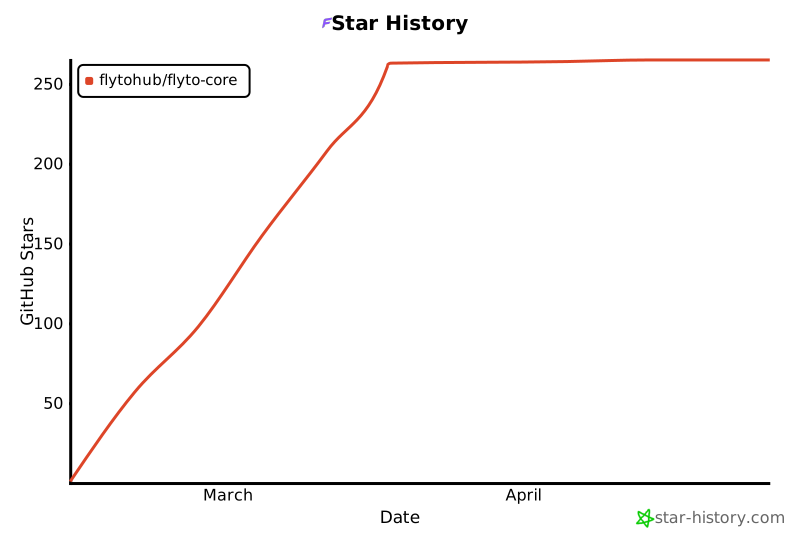
## Star History
[](https://star-history.com/#flytohub/flyto-core&Date)



