Content
# AI Mobile Reverse Skills
## Table of Contents
## Tool List
## Introduction
This is a 6-stage skill for mobile security analysis scenarios. It is used to uniformly dispatch APK static detection, traffic and code alignment, SO/JNI in-depth analysis, comprehensive analysis of encryption and vulnerabilities, verification design, and report delivery process. Supports JADX MCP, Burp/Yakit MCP, IDA/Ghidra MCP.
## I. Applicable Scenarios
- Android APK static reverse and security image analysis
- Decompiled code, packet capture results, interface field linkage analysis
- JNI / SO / native encryption, signature, wind control logic positioning
- Weak encryption, authentication authorization, component security, JSBridge, sensitive information and other risk closure
- Authorization test environment under the minimum verification scheme and POC template design
- Mobile penetration test report and structured Findings delivery
## II. Architecture Design
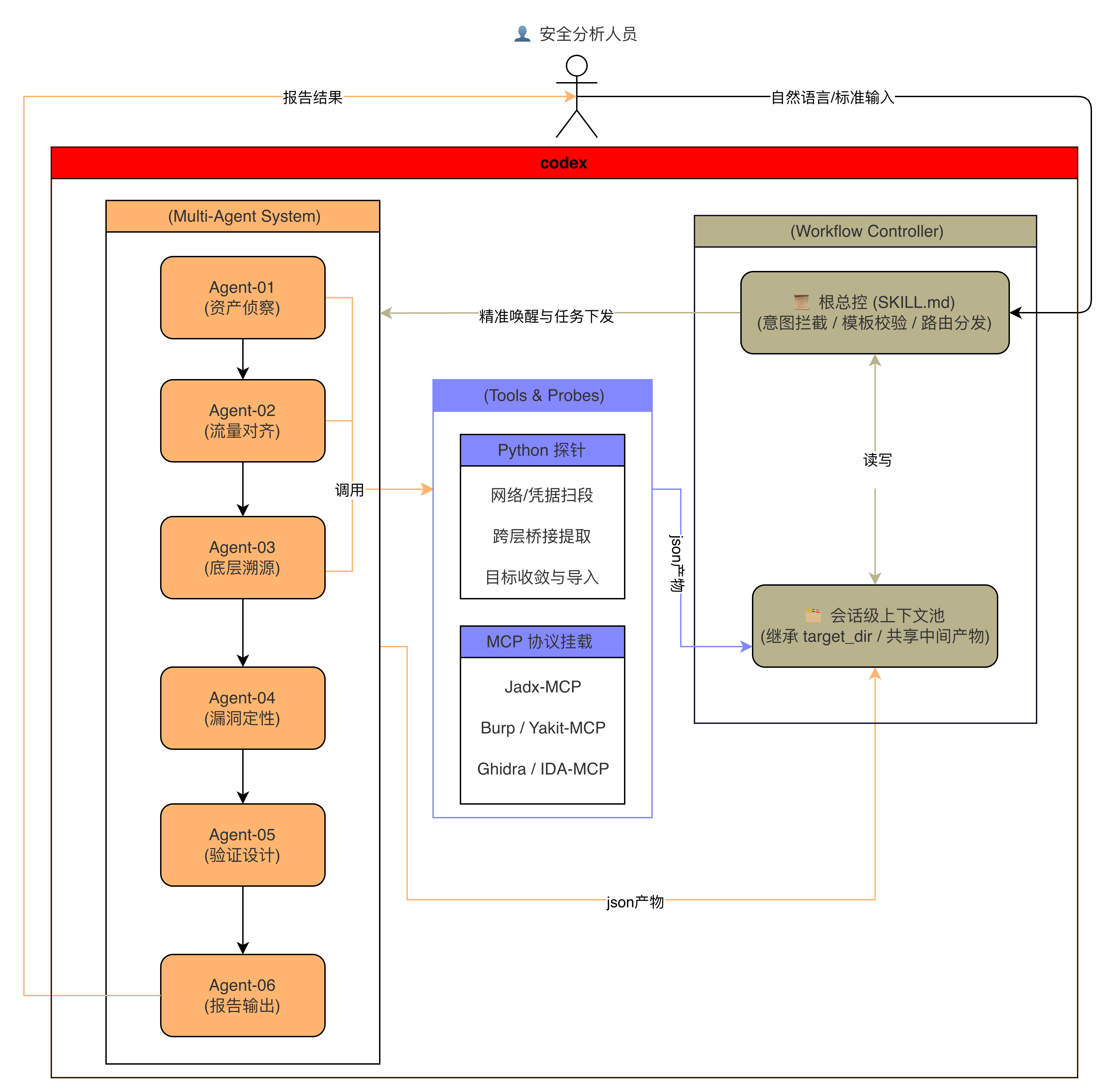
The main components are:
- Root control SKILL.md: As the scheduling center of the entire process, responsible for intention interception, standard input template return, task routing distribution, and phase execution rules constraints.
- 6 stage Agents: Customized rule sets for the entire life cycle of mobile security analysis, covering from the first stage of APK static detection to the sixth stage of security report summary.
- MCP phase access specification: Clarifies the access and call standards of Jadx-MCP (static analysis), Burp/Yakit-MCP (analysis), and Ghidra/IDA-MCP (Native deep mining) in different stages.
- Local index script (Python probe): A toolset for high coverage blind scan, including interface extraction (endpoint_extractor.py), hard-coded scanning (secret_scanner.py), JNI bridging index, and target SO automatic convergence and loading tool.
- Unified structured output design: Through standardized JSON and Markdown output, ensure that the analysis clues of the previous stage can be automatically inherited and deeply linked by the subsequent Agent.
```text
ai-mobile-reverse-skills/
├── SKILL.md # Total control entrance: stage routing, input template, execution rules
├── README.md # User manual: process description, complete example, interaction method
├── agents/ # Six-stage Agent rule set
│ ├── agent-01-sample-recon.md # Phase 1: APK static detection
│ ├── agent-02-protocol-mapper.md # Phase 2: Traffic and code alignment
│ ├── agent-03-crypto-native-analyzer.md # Phase 3: SO / JNI in-depth analysis
│ ├── agent-04-crypto-vuln-analyzer.md # Phase 4: Weak encryption and high-risk vulnerability screening (including Guardian L1-L5)
│ ├── agent-05-validation-designer.md # Phase 5: Minimum verification POC design
│ └── agent-06-reporter.md # Phase 6: Security report summary
├── docs/ # Phase access and supplementary documents
│ ├── STATE-MODEL.md # State model (analysis_state + session_blackboard)
│ └── MCP-INTEGRATION.md # MCP phase access specification
├── templates/ # Report and reproduction template
│ ├── analysis_state.template.json # Phase process state initialization template
│ ├── session_blackboard.template.json # Cross-phase knowledge accumulation initialization template
│ ├── mobile-reverse-report-template.md # Mobile security report template
│ └── repro-steps-template.md # Reproduction steps template
├── tools/ # Supporting tools and template resources
│ ├── frida/ # Frida related templates
│ │ ├── README.md # Frida template description
│ │ ├── android_phase1_bypass.js # Phase 1 runtime preparation / observation template
│ │ └── dex_dumper_art.js # ART DEX dump template
│ ├── poc_templates/ # POC / verification template
│ │ ├── README.md # POC template description
│ │ ├── CASE_README.md.tmpl # Single vulnerability verification description template
│ │ ├── frida_runtime_observe.js.tmpl # Frida runtime observation template
│ │ └── python_http_validation.py.tmpl # HTTP verification script template
│ └── scripts/ # Local index script
│ ├── README.md # Script description and sample schema
│ ├── endpoint_extractor.py # Interface / URL / field clue extraction
│ ├── env_guard_indexer.py # Root / proxy / Frida / SSL Pinning clue extraction
│ ├── native_bridge_indexer.py # JNI / JSBridge / native crypto clue extraction
│ ├── secret_scanner.py # Hard-coded key / Token / certificate / cloud credential scanning
│ ├── ai_summarizer.py # Index script execution generates compressed summary
│ ├── sign_rebuilder.py # Phase 5 signature recalculation, supporting 17 algorithms
│ ├── resolve_native_target.py # Automatically converge to the SO target of Phase 3 priority analysis
│ ├── ghidra_target_loader.py # Automatically import target SO to Ghidra project
│ └── ida_target_loader.py # Automatically import target SO to IDA (headless library + GUI)
```
## III. How to Use this Repository
The core entrance of this repository is:
- `ai-mobile-reverse-skills/SKILL.md`
When used as a Skill package, put `ai-mobile-reverse-skills/` into the Codex / AI Skill search directory that supports `SKILL.md`, or let Codex directly read `SKILL.md` in the current workspace. The stage documents, scripts, and templates inside the repository are referenced with `ai-mobile-reverse-skills/` as the relative root directory.
If you just want to understand the process, read `ai-mobile-reverse-skills/USER-README.md`; if you want to execute the complete stage rules, take `ai-mobile-reverse-skills/SKILL.md` and 6 Agent documents under `agents/` as the standard.
## IV. Phase Process Description
| Phase | Agent | Goal | Main Output |
| --- | --- | --- | --- |
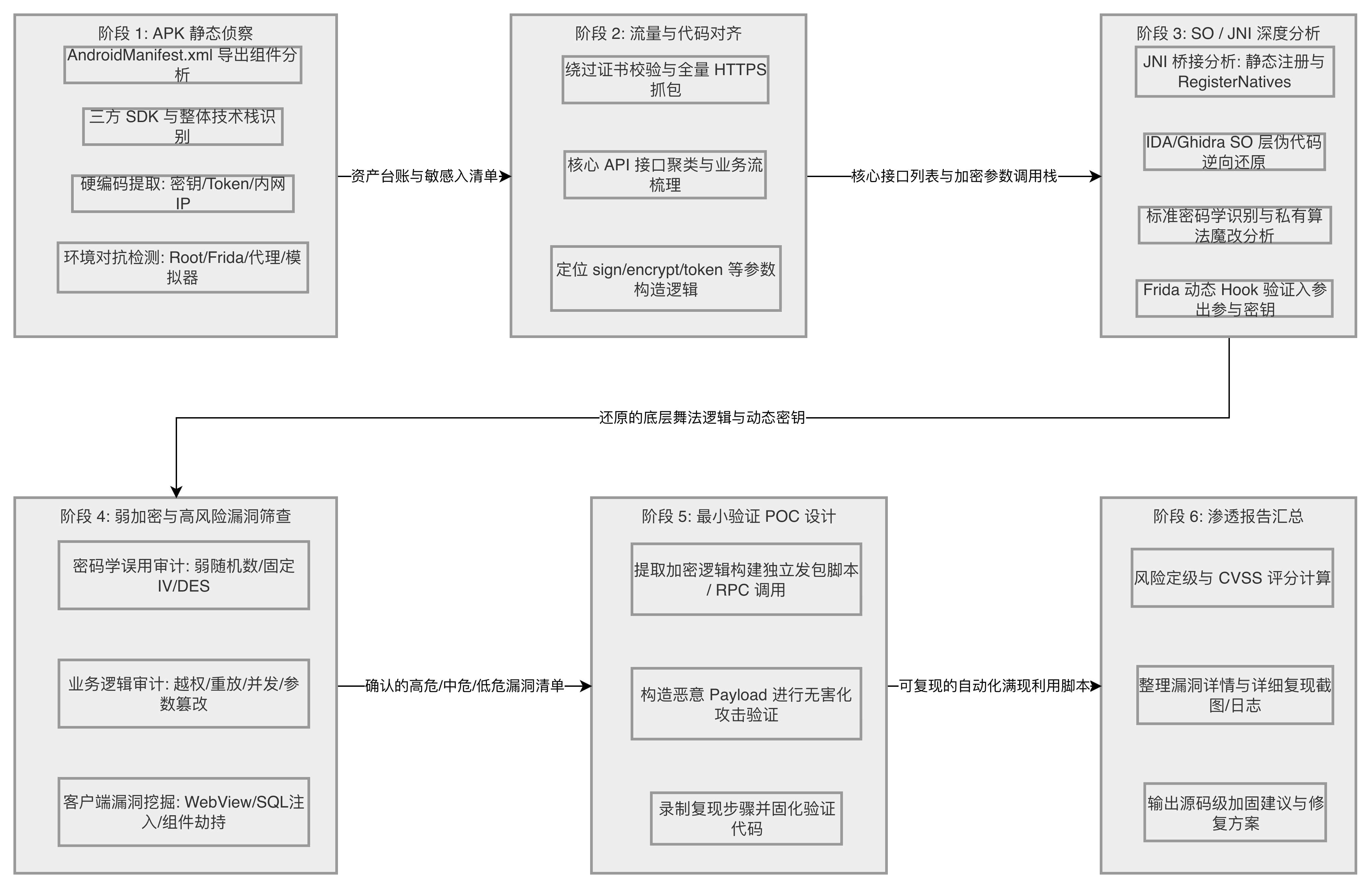
| Phase 1 | SampleRecon | APK static detection, technical stack identification, environment detection, sensitive entrance and SO clue initial screening | `file_inventory.json`, `tech_stack.json`, `entrypoints.json`, `env_guard_report.json` |
| Phase 2 | ProtocolMapper | Align packet capture request, interface field, signature parameter, and code implementation | `api_endpoints.json`, `protocol_map.json`, `traffic_alignment.json` |
| Phase 3 | CryptoNativeAnalyzer | Analyze JNI / SO / native encryption and signature logic around Phase 2 clues | `crypto_native_analysis.json`, `jni_analysis.json` |
| Phase 4 | CryptoVulnAnalyzer | Comprehensive previous evidence, close weak encryption and high-risk vulnerabilities; each vulnerability outputs Guardian L1-L5 evidence depth label | `vuln_analysis.json` (including `guardian_level`), `risk_matrix.json` (including `phase5_priority_queue`), `secrets_report.json`, `jsbridge_analysis.json` |
| Phase 5 | ValidationDesigner | Design minimum verification scheme and POC template under authorized environment | `validation_cases.json`, `test_plan.md`, `repro_steps.md` |
| Phase 6 | Reporter | Summarize Phase 1-5, generate delivery report and Findings | `security_report.md`, `findings.json` |
All modes start from Phase 1. Automatic chain will not skip the first phase.
## V. MCP Access Description
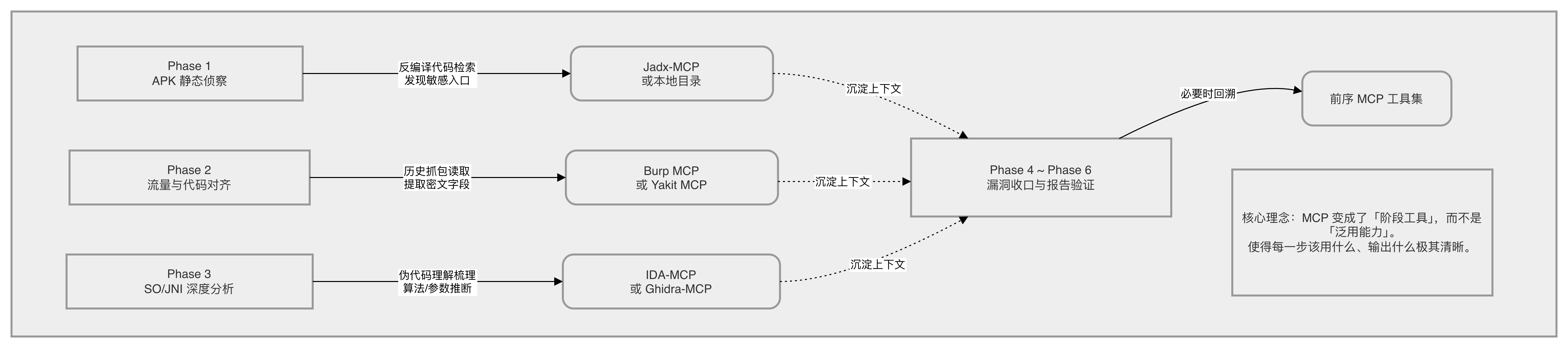
MCP is a tool context entrance, not an alternative to phase judgment. This skill uses the following MCPs.
| MCP | Main Purpose | Typical Phase |
| --- | --- | --- |
| `jadx-mcp` | Read Jadx current sample class, method, resource, string, and call clue | Phase 1, Phase 4 |
| Burp MCP / Yakit MCP | Read packet capture request, Header, Body, response summary, and interface scene | Phase 2, Phase 5 |
| `ida-mcp` / `ghidra-mcp` | Analyze SO, JNI, pseudo-code, cross-reference, and native encryption logic | Phase 3 |
Complete specification see:
- `ai-mobile-reverse-skills/docs/MCP-INTEGRATION.md`
## VI. Running Mode
### 5.1 Step-by-Step
Suitable for scenarios where each step needs manual review and adjustment of analysis focus.
```text
run_mode: step_by_step
```
Features:
- Each phase ends with default suspension
- Artificial confirmation of current phase results before entering the next phase
- Suitable for complex samples, unstable packet capture preconditions, and projects that require step-by-step judgment
### 5.2 Automatic Chain
Suitable for scenarios with complete pre-materials, hoping the system will continuously promote the report.
```text
run_mode: auto_chain
auto_chain_mode: A/B/C
```
| Mode | Automation Range | Suitable Situation |
| --- | --- | --- |
| A | Phase 1 artificial confirmation, Phase 2-6 automatic promotion | After the first phase, manual completion of proxy, packet capture, MCP connection, etc. is required |
| B | Phase 1-3 artificial confirmation, Phase 4-6 automatic promotion | Artificial excavation in the front, and then vulnerability closure, verification, and report automation |
| C | Phase 1-6尽量自动推进 | Already prepared for decompiled directory, packet capture, MCP, and native analysis materials before startup |
Automatic chain will pause at the earliest blocking stage when encountering critical condition loss, such as lack of packet capture results, lack of `ghidra_root`, lack of previous phase output, etc.
## VI. Quick Start
It is recommended to start with a "two-stage" approach: select the mode first, and then enter the first phase.
### 6.1 Select Mode
Manual step-by-step execution:
```text
run_mode: step_by_step
```
Or choose automatic chain:
```text
run_mode: auto_chain
auto_chain_mode: B
```
### 6.2 Provide First-Stage Input
Analyze local decompiled directory:
```text
step: 1
analysis_mode: local_source
target_dir: sample_target/decompiled
output_dir: analysis_runs/current_run
jadx_mcp: no
```
Use current Jadx MCP session:
```text
step: 1
analysis_mode: jadx_mcp_session
output_dir: analysis_runs/current_run
jadx_mcp: yes
```
Field description:
- `analysis_mode`: `local_source` indicates analysis of local decompiled/unpacked directory, `jadx_mcp_session` indicates use of opened Jadx MCP session
- `target_dir`: Decompiled main analysis directory; not required when using Jadx MCP
- `output_dir`: Unified output directory, default inheritance for subsequent phases
- `jadx_mcp`: Whether `jadx-mcp` is connected
## VII. Update Description
### 2026/4/23
Initial release
### 2026/5/20
- Added `ai_summarizer.py`: Automatically generates compressed summary after execution of 4 index scripts, reducing AI token consumption
- Added `sign_rebuilder.py`: Supports 17 algorithms and pipeline chain combination, Phase 5 directly generates sign reproduction request
- `ghidra_target_loader.py` supports macOS and Windows, users need to fill in `ghidra_root` in advance
### 2026/6/28
- Added `session_blackboard.json`: Key findings of each phase (key, native target, encryption algorithm) are written to the shared blackboard, and downstream phases directly read without repeated derivation
- Added Phase 2 → Phase 3 Intent directional signal: Phase 2 locks the target SO and field into the blackboard, and Phase 3 directly starts analysis from the specified target
- Added Guardian L1-L5 evidence depth label: Each vulnerability is labeled with exploitability (Phase 4 static maximum judgment to L4 can directly output PoC / L3 needs Frida confirmation / L2 call chain to be completed; L5 is Phase 5 runtime confirmation), `risk_matrix.json` synchronously outputs Phase 5 priority work queue
- Added auto_chain quality gate: Automatically checks the number of new discoveries after the phase is completed. If it is zero, a warning is written to the downstream, and each phase quality can be perceived.