Content
# agentsense
**Make sense of what your AI agents did.** A local-first, MCP-native observability &
debugging tool: a transparent MCP proxy traces every protocol message with **zero code
change to the agent**, PII is redacted deterministically on the write path, and traces
are stored whole (no field whitelist) in local SQLite — then **replayed and diffed** to
see how a different model would have decided.
*Apache-2.0 · local-first · no cloud signup*
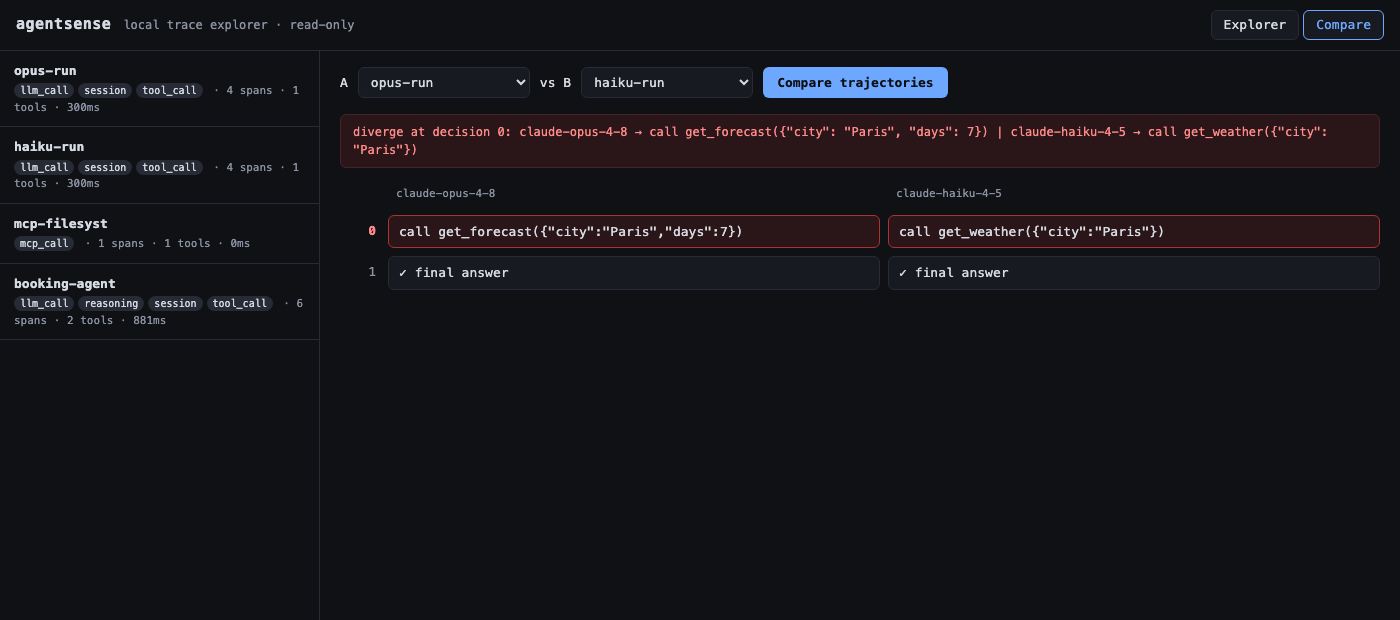
> *Compare view — the same run replayed against two models; the first point where their decisions diverge is highlighted.*
## What makes it different
Agent-observability tools each miss at least one of these — agentsense combines all four:
- **Local-first** — runs entirely on your machine; no cloud signup or account.
- **MCP-native** — instruments inside the Model Context Protocol at the wire, not
wrapped via OpenTelemetry, so it traces tool calls with zero code change.
- **Trace replay + trajectory diff** — re-run a recorded trace against a different
model and see exactly where the decisions diverge.
- **Open source** — Apache-2.0.
## Why it's useful
When an AI agent misbehaves — wrong tool, bad decision, runaway cost — you are usually
guessing. agentsense gives you ground truth:
- **Protocol-level tracing with zero code change.** Point the agent's MCP config at the
proxy and every tool call, input/output, latency, and cost is captured — even for
agents you can't instrument.
- **"Would a different model fix this?"** Replay a recorded trace against another
model/prompt, feeding back stored tool results, and diff the trajectory to see exactly
where behaviour diverges — no live tool calls, no API cost, no side effects.
- **Compliance-ready audit trails.** PII is redacted deterministically *before* it is
ever stored, and the redaction itself is logged — the audit-trail story for EU AI Act
enforcement (from August 2026).
- **Local-first.** No cloud signup, fully self-hostable.
## What's included
| Component | Module | Status |
|---|---|---|
| MCP proxy (stdio, transparent) | `proxy/` | ✅ |
| Deterministic PII redaction | `redaction/` | ✅ write-path |
| SQLite trace store (whole objects) | `store/` | ✅ |
| Replay + trajectory diff | `replay/` | ✅ pluggable model client |
| Python capture SDK | `sdk/` | ✅ OTel GenAI conventions |
| Local trace-explorer UI | `ui/` | ✅ read-only, FastAPI |
## Design guarantees
- Proxy forwards raw bytes **unchanged**; only a *copy* is parsed for tracing.
- Logs go to **stderr / file, never stdout** (stdout is the JSON-RPC channel).
- Trace store preserves **unknown/vendor fields** — whole objects, no whitelist.
- Redaction is **deterministic** (hash-derived tokens) so replay aligns.
## Install
```bash
pip install agentsense-ai # distribution name; the CLI and import are `agentsense`
# extras: pip install "agentsense-ai[ui,replay]" # web UI + live-replay model clients
```
The install/import names differ (like `scikit-learn` → `sklearn`): the package is
`agentsense-ai`, but you run `agentsense …` and `import agentsense`.
## How it's used
Capture → explore → replay:
1. **Capture a run** — either or both:
- *Zero code change:* put the proxy in front of your MCP server ([Quick start](#quick-start)) — it traces every tool call.
- *Richer detail:* wrap your own loop with the [capture SDK](#capture-sdk) to also record reasoning and model calls.
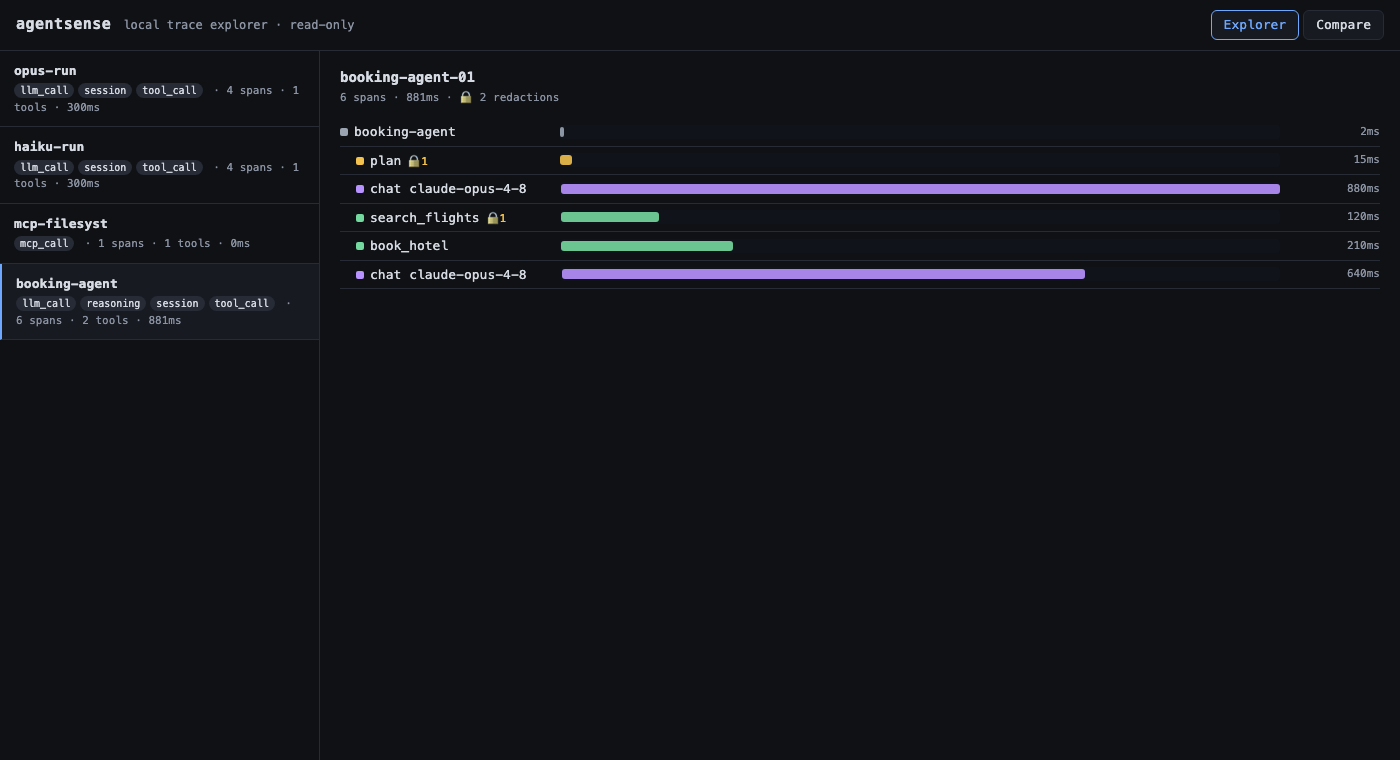
2. **Explore** — `agentsense ui --db traces.db` opens the [trace explorer](#ui-local-trace-explorer): span tree, timeline, PII-redaction badges.
3. **Replay** — re-run a captured trace against a different model and [diff the trajectory](#replay--trajectory-diff) to see where its decisions change.
## Quick start
The proxy is a stdio MCP server your client launches, wrapping the real server. Add it to
your MCP client's config (e.g. Claude Desktop, Cursor):
```jsonc
{
"mcpServers": {
"filesystem": {
"command": "agentsense",
"args": ["proxy", "--db", "traces.db",
"--", "npx", "-y", "@modelcontextprotocol/server-filesystem", "/data"]
}
}
}
```
Use your agent as usual, then explore what it did:
```bash
agentsense ui --db traces.db # opens http://127.0.0.1:8000
```
**Just want to see it work now?** Drive it with the MCP Inspector — no config edit:
```bash
npx @modelcontextprotocol/inspector \
agentsense proxy --db traces.db -- npx -y @modelcontextprotocol/server-filesystem /tmp
# make a tool call in the Inspector, then: agentsense ui --db traces.db
```
## Tests
```bash
uv run pytest # unit tests run offline; the proxy has no model dependency
uv run ruff check .
```
`test_proxy_transparency.py` is an integration test that drives `server-filesystem`
through the proxy with a real MCP client; it self-skips if `npx` is unavailable.
## UI (local trace explorer)
A read-only web app over the trace store — no build step, no Node. It serves a JSON
API and a single static page (trace list → span tree + timeline + redaction badges).
```bash
uv sync --extra ui
uv run agentsense ui --db traces.db # opens http://127.0.0.1:8000
```
The **Compare** tab renders the side-by-side trajectory diff: pick two captured traces
and see their decision sequences aligned, with the first point of divergence highlighted.
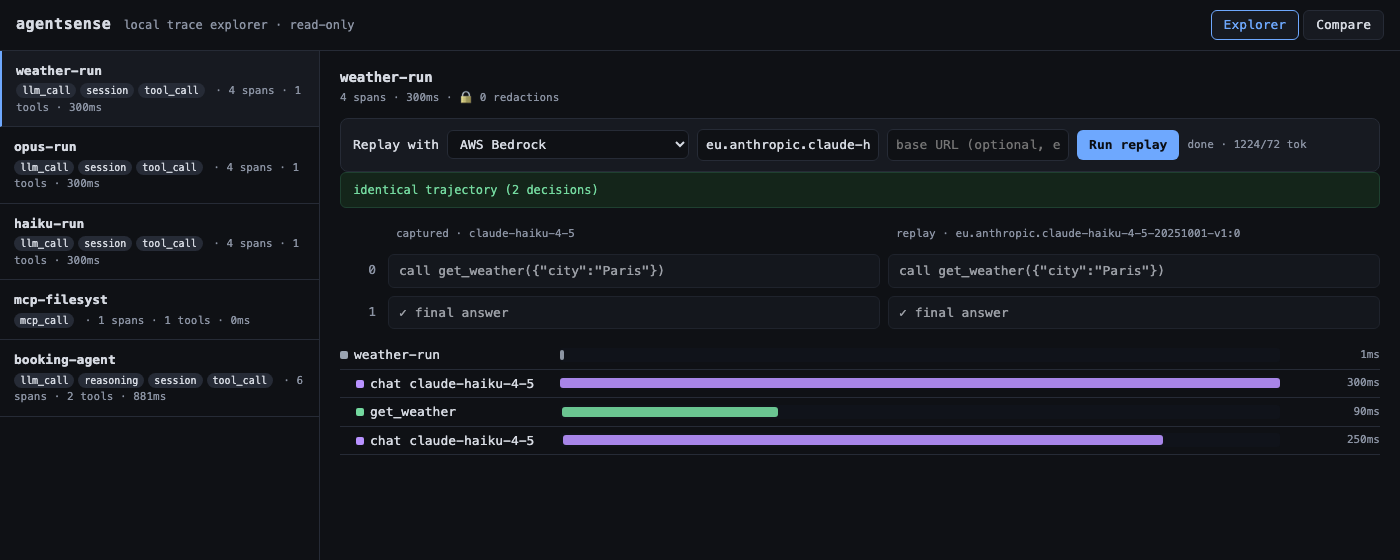
**Live replay** — on any captured trace, pick a model and re-run it right there: agentsense
rebuilds the recording, replays it against your chosen model (OpenAI-compatible/Ollama or
AWS Bedrock), and diffs the result against what the agent actually did. Ephemeral — no
store writes.
Endpoints: `GET /api/traces`, `GET /api/traces/{id}/spans`, `GET /api/diff?a=&b=`,
`POST /api/replay`. The frontend is plain HTML/JS in `ui/static/` — swappable for React
later behind the same API.
## Capture SDK
For agents you *can* instrument, the SDK records reasoning-level detail the proxy can't
see. It writes through the same store — and therefore the same redaction path — as the
proxy, using OpenTelemetry GenAI attribute naming (`gen_ai.*`) for interop.
```python
from agentsense.sdk import Tracer
from agentsense.store import SpanStore
tracer = Tracer(SpanStore("traces.db"))
with tracer.session("booking-agent") as s:
s.step("plan", reasoning=..., model="claude-opus-4-8")
s.llm_call("claude-opus-4-8", messages=[...], response={...},
usage={"input_tokens": 1200, "output_tokens": 80})
s.tool_call("search_flights", args={...}, result={...}, cost=0.002)
```
Spans form a shallow tree (session → steps). `llm_call` stores the whole conversation
(messages, tools, response) so a captured run can be reconstructed into a replayable
`Recording`. Demo: `uv run python examples/sdk_capture.py`.
## Replay + trajectory diff
Re-drive an agent run against a different model, **injecting recorded tool results**
(the engine cannot call a live tool — the guarantee holds by construction), then diff
the two decision trajectories to find the first point of divergence.
```bash
# Offline, no creds — two scripted "models" over the same recorded results:
uv run python examples/replay_scripted.py
# → diverge at decision 0: haiku-4.5 → call get_weather(...) | opus-4.8 → call get_forecast(...)
```
The model client is **pluggable behind one adapter** (`replay/adapters/`): `BedrockAdapter`
(AWS Bedrock Converse), `OpenAICompatAdapter` (OpenAI, Ollama, or any OpenAI-compatible
endpoint), and `ScriptedAdapter` (offline/tests). The engine speaks only provider-neutral
types — swapping providers never touches it. Recorded tool results can be supplied directly
or pulled from a captured proxy trace via `Recording.from_trace_store(...)`.
### Capture → replay (the full loop)
An SDK-captured run replays end-to-end: `Recording.from_sdk_trace(store, trace_id)`
reconstructs the question, tools, model, and recorded tool results, and
`captured_trajectory(store, trace_id)` reconstructs what the agent *actually did*. Diff
the two to answer "would a different model have decided differently than my agent did?"
```bash
uv run python examples/capture_then_replay.py
# → diverge at decision 0: claude-haiku-4-5 → call get_weather(...) | rushed-model → final answer
```
## Model access (live replay only — not needed for the proxy)
Live replay calls a model, so it needs credentials for whichever provider you pick —
either an OpenAI-compatible endpoint (`OPENAI_API_KEY`, or a local Ollama base URL) or AWS
Bedrock. For the Bedrock example:
```bash
aws sso login --profile <your-aws-profile> # temporary SSO creds
export AWS_PROFILE=<your-aws-profile> AWS_REGION=eu-west-1
uv run --extra replay python examples/replay_bedrock.py
```
## Contributing
Issues and PRs welcome — see [CONTRIBUTING.md](./CONTRIBUTING.md). All tests run offline
(`uv run pytest`); the proxy has no model dependency.
## License
[Apache License 2.0](./LICENSE) — includes an explicit patent grant.
 MCP Store
