Content
# DataCharter
> Explore all your data locally, in one place — contract-governed data exploration, powered by DuckDB
[](https://pypi.org/project/datacharter/)
[](https://pypi.org/project/datacharter/)
[](LICENSE)
Contract-governed local data exploration, **powered by [DuckDB](https://duckdb.org)**.
Define your sources as data contracts
([ODCS](https://bitol-io.github.io/open-data-contract-standard/)-compatible YAML),
query them through DuckDB's SQL federation engine with real source pushdowns,
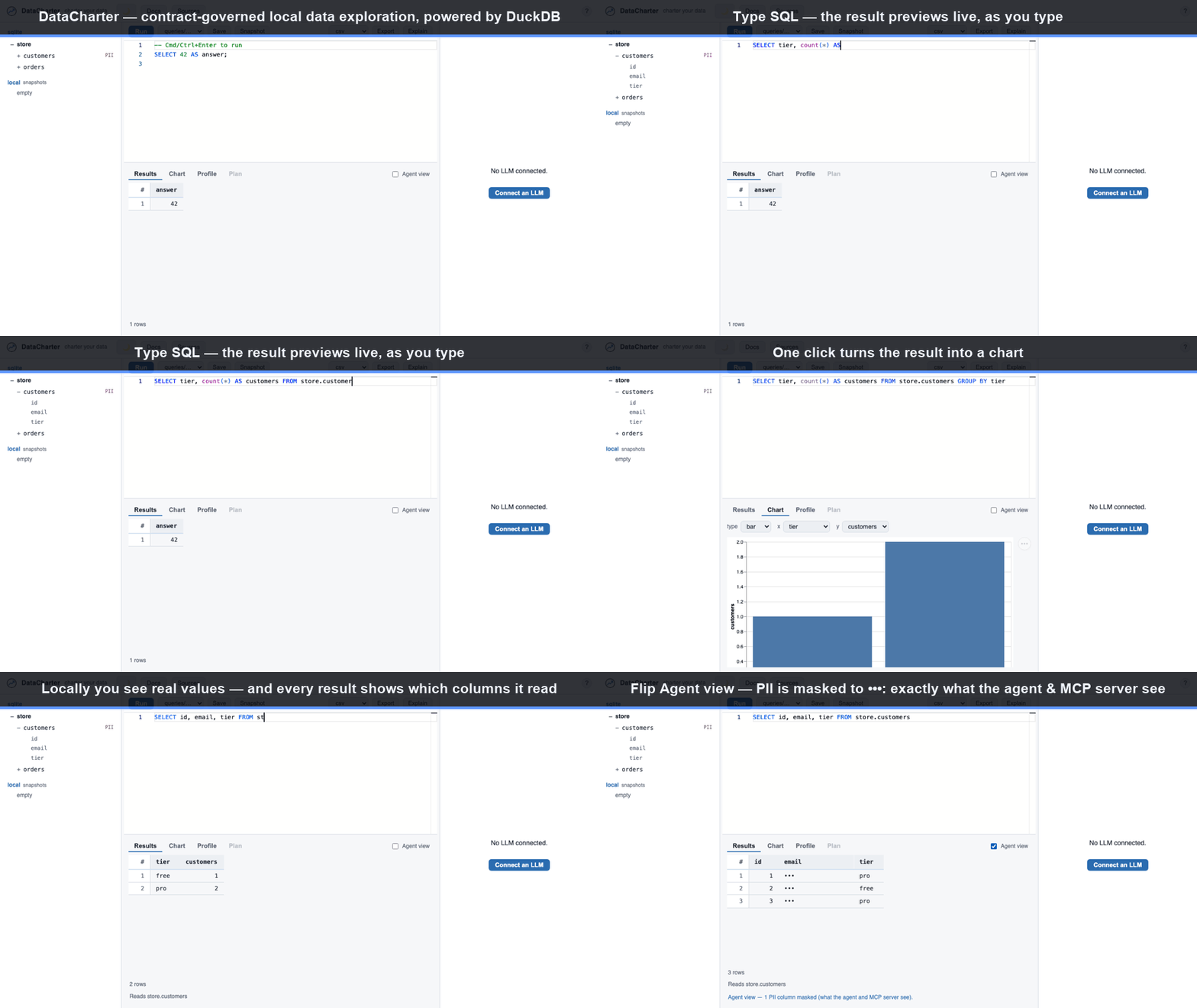
and explore in a local web UI — SQL editor with live preview, auto-charts,
profiling. Every answer shows which source columns it read; ask questions in
plain language or serve the whole thing to an AI agent over [MCP](docs/mcp.md),
with PII masked from the model — all on your machine.
## What you can do
- **Drop a file, query it instantly.** Drag a CSV, Parquet, or JSON onto the window and run SQL on it right away — no import, no schema setup.
- **Join across sources — no pipelines.** Query and JOIN a Postgres table, a Parquet file, and a Snowflake table in a *single* SQL statement. No ETL, no copying everything into a warehouse first.
- **Connect all your data.** Postgres, MySQL, SQLite, SQL Server, BigQuery, Snowflake, files on S3/GCS/Azure, and Iceberg/Delta tables — all through one engine.
- **See answers as you type.** Live results preview while you write SQL, one-click auto-charts, and a profiling panel (missing values, distributions, outliers) — no separate BI tool.
- **Ask in plain English (optional).** Turn a question into SQL and an answer with the built-in agent — bring your own model, or run one fully local with no API key.
- **Keep sensitive data away from the AI.** Mark PII columns once; the agent and any connected AI see masked values (`•••`) while you still see the real data locally. Flip **Agent view** to see exactly what the model sees.
- **Safe by design.** The engine is read-only by construction — no query can write, delete, or touch the filesystem — so pointing an AI (or a teammate) at your real databases can't do damage.
- **Point AI tools at your data, safely.** A governed MCP server exposes read-only, PII-masked query tools to Cursor, Cline, or your own agent.
- **Trust every answer.** Each result shows exactly which source columns it read — so you always know where a number came from.
- **Save, reuse, export.** Snapshot a result as a reusable local table; export to CSV, Parquet, JSON, or XLSX.
- **Governance you can automate.** Catch schema/PII drift in CI, auto-detect PII columns, diff data across sources, and define certified metrics — from the command line.
**Status: pre-release.** V1 in development.
## Quick start
```sh
# Try it instantly on generated demo data — no install, no config:
uvx datacharter serve # needs `uv` → https://astral.sh/uv
# → serves at http://127.0.0.1:8321 (open it in your browser)
# Or install it:
pip install datacharter # Python 3.11+
# Start your own workspace:
datacharter init # scaffolds charter.yaml, queries/, .env.example
# → add a source: edit charter.yaml, or use the "Sources" panel in the UI
datacharter serve # → http://127.0.0.1:8321
```
Then, once it's running, **drag a CSV, Parquet, or JSON file onto the window** to
query it instantly — no config needed.
**Optional natural-language agent** — point it at any OpenAI-compatible endpoint:
```sh
export OPENAI_BASE_URL=... # any OpenAI-compatible API
export OPENAI_API_KEY=...
datacharter serve
```
…or run **fully local** — no API key, no data leaves your machine (requires
[Ollama](https://ollama.com)):
```sh
ollama pull qwen3:8b # once
datacharter serve --local # qwen3:8b by default (--model to change)
```
## Why DataCharter
- **Your contracts are the catalog.** `charter.yaml` describes sources, tables,
and PII fields — the same contract spec your data team already writes, so
there's no separate metadata store to maintain.
- **Real federation, not just a shared connection.** Filters and projections are
pushed down to each source — even across a cross-source join, every leg is
filtered where its data lives. (Snowflake runs via connector extract,
`datacharter[snowflake]`, with the same pushdown into the extract.)
- **Local-first.** One process, your machine, no cloud dependency. The optional
`--local` agent runs a small open model via Ollama — no API key, no data leaves
your machine.
- **The workspace is a directory.** `charter.yaml` + `queries/*.sql` +
`.env.example` — commit it, clone it, `datacharter serve`. Your team's whole
exploration environment travels as a repo; secrets and local state never do.
DataCharter governs and audits your data, not just displays it. The full command
set (`drift`, `scan`, `diff`, `metric`, `mcp`, and more) is in the
[CLI reference](docs/cli.md); the security model is in [security](docs/security.md).
## Built on
DataCharter stands on excellent open-source foundations:
- **[DuckDB](https://duckdb.org)** — the analytical engine at our core:
federation (`ATTACH`), file formats, Iceberg/Delta, encryption, autocomplete.
- **[Open Data Contract Standard](https://bitol-io.github.io/open-data-contract-standard/)** /
[datacontract.com](https://datacontract-specification.com/) — the contract format `charter.yaml` speaks.
- **[Model Context Protocol](https://modelcontextprotocol.io)** — the open protocol
the `datacharter mcp` server speaks to agents and MCP clients.
- **[Vega-Lite](https://vega.github.io/vega-lite/)** — declarative charting.
- **[Monaco Editor](https://microsoft.github.io/monaco-editor/)** — the SQL editor.
- **[TanStack Table & Virtual](https://tanstack.com/)** — the virtualized results grid.
- And the Python & React ecosystems — FastAPI, pydantic, httpx, keyring, and
ruamel.yaml on the backend; React and Vite on the front.
Testing uses **[VidaiMock](https://github.com/vidaiUK/VidaiMock)**, an
Apache-2.0 mock LLM server, as the offline agent endpoint in CI.
DuckDB is a trademark of the DuckDB Foundation. DataCharter is an independent
project and is not affiliated with or endorsed by the DuckDB Foundation.
## License
[Apache-2.0](LICENSE)
 MCP Store
